decodedscience
  • オンラインカジノ
  • 私たちについて

Little Lichens: More Than a Plant

November 26, 2012 by Tricia Edgar 14 Comments

Share16
+13
Share
Pin731
Tweet
Shares 750

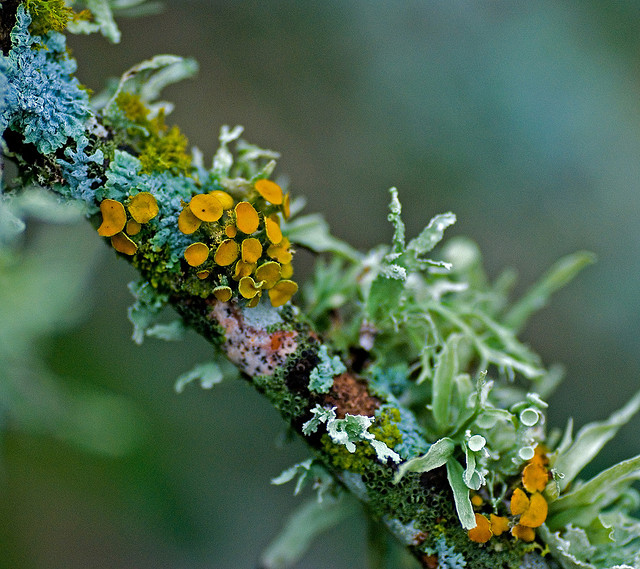
Lichen look like tiny plants, but they’re actually a fusion between a plant and a fungus. Photo: Jim McCulloch.

It’s another chilly, damp day in the temperate rainforest.

The mosses that hang from the trees drip slowly.

The streams run through the forest. Amongst the fallen branches, there are little greenish-grey bits of plants.

Some of them look vaguely like an exotic type of lettuce. Others are hard and lie flat on the branches.

What are these strange, plant-like green things?

They are lichens, and although they might look like plants, they are not. They’re plants… and they’re something more. If lichens had a Facebook status, it would likely be “it’s complicated.”

What is a Lichen?

Like the slime molds, lichens are a hybrid; a symbiotic relationship between an algae and a fungus.

There is a terrible joke in the naturalist community, and it goes something like this: a lichen is a fungus and an algae, and they’re likin’ one another. Terrible jokes aside, lichens consist of an algae called a photobiont and a fungus called a mycobiont. Together they form something a little bit different – something that allows both the algae and the fungus to live well.

How does this relationship benefit both parties? Most of the fungi in this relationship are not able to survive without an algal partner. Plants have a superpower that animals and fungi do not have: they can make their own food through photosynthesis. This is very useful for the fungal part of the lichen, since it needs this food to survive.The fungus harvests these sugars, sending out chemicals to help them diffuse through the permeable cell walls of the algae. Most of the algae can survive on their own, but they may need a very specific habitat in order to do so. By cohabiting with the fungus, the algae can live in many different environments and extend its range significantly.

Different lichens contain different kinds of fungi, and it is this that helps classify lichens into different species.
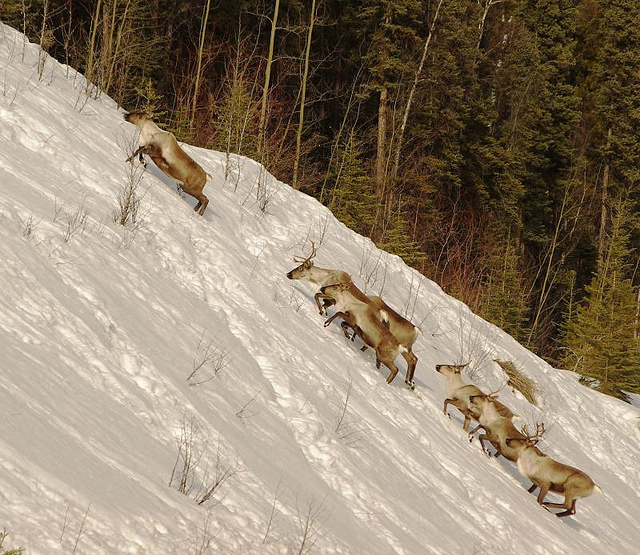
Caribou need lichen for food. Photo: Watson Lake

Lichens Are Tiny But Tasty

In the north, lichens are an important food source for caribou. Few plants grow in these areas, and the plants that grow well often grow in the short northern summers. In more southern areas where the winter snow makes it more difficult for animals to find food, the lichen that drops down to the top of the snow also a helpful source of food for hoofed mammals. Lichens are also good building materials for hummingbirds. These tiny birds use little bits of lichen in their nest-building activities.

Lichens Make Air Quality Visible

Lichens are useful to humans as well. They’re a good indicator of long term air quality, since certain lichens such as the Usnea species can only grow in areas with good air quality. Other species such as Parmelia and Physcia can grow in areas with poorer air quality. Mapping these lichens is useful to those who are trying to map air quality, and changes in lichen species can reveal changes in air quality over time. The US Forest Service has a lichens and air quality database.

Lichens: Small But Critical

While lichens may be small, they are an important food source and indicator species. These little hybrids are also a fascinating study of the complementary natural relationships that exist on a tiny scale.

Resources

Beck, A., Mayr, C. Nitrogen and carbon isotope variability in the green-algal lichenXanthoria parietina and their implications on mycobiont–photobiont interactions. (2012). Accessed November 26, 2012.

Environment Canada. Monitoring Lichens As Indicators of Air Quality. Accessed November 25, 2012.

Sharnoff, Stephen and Roger Rosentreter. Wildlife Use of Lichens. Bureau of Land Management. 1998. Accessed November 25, 2012.

© Copyright 2024 Tricia Edgar, All rights Reserved. Written For: Decoded Science
Share16
+13
Share
Pin731
Tweet
Shares 750

Filed Under: Ecology, Headlines

Comments

  1. Moses says

    January 6, 2017 at 7:41 pm

    Sorry, I don’t think It is photobiont, I think it is phycobiont.

    Reply
  2. Gabriella Hanner says

    November 30, 2016 at 1:41 pm

    i liked it but the relationship of it didn’t make sins

    Reply
  3. Busia Loyalty says

    November 2, 2016 at 1:50 am

    it hasn’t given the details for the rel/tshp that I intended to get…. Huh?! Whereas av an exam in the next few minutes

    Reply
  4. Hunaina says

    April 12, 2016 at 9:13 am

    It doesn’t tell about the relationship???? B/w fungus and alga in lichen for which I was looking for????? !!!!!….

    Reply
  5. Caden Beroza says

    March 15, 2016 at 11:33 am

    Is the realationship mutalism, commenisalim or paratism

    Reply
    • 1 says

      April 28, 2016 at 6:56 am

      mutalism

      Reply
  6. Sudhir Kannaujiya says

    July 31, 2015 at 10:50 pm

    Nice job

    Reply
  7. Anil says

    July 30, 2015 at 5:55 am

    Very lucid and informative… Good job!!!

    Reply
  8. bignob says

    November 23, 2014 at 6:20 pm

    this is a good website but y donate 5000000

    Reply
  9. Bill says

    May 30, 2014 at 8:33 am

    Cool but not what I was looking for. Plus why donate?

    Reply
    • John Jaksich says

      May 31, 2014 at 12:27 am

      Quality content deserves to be acknowledged. Writers invest a good portion of themselves so you could discern it for yourself.

      Reply
  10. Stefanie Farrington says

    April 10, 2014 at 4:30 pm

    Algae aren’t plants, even though they can carry out photosynthesis. Otherwise very helpful!

    Reply
  11. Jacki says

    May 30, 2013 at 6:02 pm

    hmmm. I just learned a lot. Terrific job, Tricia!
    @interesting

    Reply
  12. Jacki says

    May 30, 2013 at 6:01 pm

    very confusing. but cool to learn. Nice piece!

    Reply

Leave a Reply Cancel reply

Connect with:
Facebook

Your email address will not be published. Required fields are marked *

About the Author

Tricia Edgar

Tricia Edgar holds a Master’s degree in Environmental Management. Her research focused on the ecological restoration of watersheds in British Columbia, Canada and in several locations in the Philippines. She works teaching … Read Full Profile
signupheredailydosedecsciv2

Get Hooked on Science – Click to read all Decoded Science articles here!

Here’s What Everyone’s Reading

  • Genetically Modified Organisms: Pros and Cons of GMO Food Genetically Modified Organisms: Pros and Cons of GMO Food What are the benefits and risks of genetically modified… under Headlines
  • Stomach Flu Cramps: Is There Anything You Can Do For Norovirus Symptoms? Stomach Flu Cramps: Is There Anything You Can Do For Norovirus Symptoms? Stomach cramps are a painful symptom of the stomach flu… under Headlines
  • Ethyl Mercury vs. Methyl Mercury: What’s The Difference? Ethyl Mercury vs. Methyl Mercury: What’s The Difference? Methylmercury and ethylmercury are two organic mercury … under Ask the Expert
  • Practical Uses of Matrix Mathematics Practical Uses of Matrix Mathematics What are the practical use of matrices in day to day li… under Ask the Expert
  • MOOCs for the Masses: Closing the Global Achievement Gap with Online Courses MOOCs for the Masses: Closing the Global Achievement Gap with Online Courses MOOC, or Massive Online Open Courses, hold an enormous … under Headlines
  • Vanuatu, the Drake Passage and (Not) Alaska: Earthquakes 26 January-1 February 2017 Vanuatu, the Drake Passage and (Not) Alaska: Earthquakes 26 January-1 February 2017 In a quiet week, we’re looking at smaller earthquakes i… under Weekly Features
  • Viruses: A Complex Chemistry? Viruses: A Complex Chemistry? Because there are a large number of deadly viruses that… under Headlines
  • Why Tarantulas Always Choose Miss Right Why Tarantulas Always Choose Miss Right How do spiders choose a Valentine? New research indicat… under Life Science
  • Animal Magnetism: How the Magnetic Field Influences Animal Navigation Animal Magnetism: How the Magnetic Field Influences Animal Navigation If you’ve ever wondered how birds, butterflies and othe… under Headlines
  • Can Texas Legally Secede from the United States? Can Texas Legally Secede from the United States? Recent White House ‘We The People’ petitions have raise… under Headlines
  • Ozone Layer Depletion vs Greenhouse Effect: What’s the Difference? Ozone Layer Depletion vs Greenhouse Effect: What’s the Difference? Is there a connection between the hole in the ozone lay… under Headlines
  • Did the Temple of Solomon Define Pi in the Bible? Did the Temple of Solomon Define Pi in the Bible? King Solomon’s temple featured a ‘Molten Sea’ that incl… under Headlines

Most Popular Posts Today

  • Genetically Modified Organisms: Pros and Cons of GMO Food Genetically Modified Organisms: Pros and Cons of GMO Food
  • Stomach Flu Cramps: Is There Anything You Can Do For Norovirus Symptoms? Stomach Flu Cramps: Is There Anything You Can Do For Norovirus Symptoms?
  • Which Chemical Bond is Stronger: Ionic vs. Covalent Bonds Which Chemical Bond is Stronger: Ionic vs. Covalent Bonds
  • Introducing Math Symbols for Union and Intersection Introducing Math Symbols for Union and Intersection
  • Flu Symptoms: How You’ll Feel if You Catch the Influenza Virus Flu Symptoms: How You’ll Feel if You Catch the Influenza Virus
  • Cross Multiply to Solve Equations with Fractions Cross Multiply to Solve Equations with Fractions
  • Organ Harvesting, Human Trafficking, and the Black Market Organ Harvesting, Human Trafficking, and the Black Market

© 2026 DecodedScience

MENU
  • Home
  • Headlines
  • General Science
  • Applied Science
    • Calculations
    • Economics
    • Engineering
      • Aviation
      • Civil Engineering
    • Medical Science
      • Health
      • Neuroscience
      • Oncology
      • Veterinary Science
    • Political Science
      • Polling
    • Mathematics
    • Technology
      • Artificial Intelligence
      • Computing
      • Electronics
      • Gadgets
    • Social Science
      • Cognitive Science
      • Psychology
      • Sociology
      • Anthropology
        • Linguistics
  • Physical Science
    • Archaeology
    • Astronomy
    • Chemistry
      • Materials Science
    • Geoscience
      • Climate Change
      • The Environment
      • Geology
      • Meteorology
      • Oceanography
    • Life Science
      • Biology
        • Botany
        • Zoology
          • Marine Biology
          • Entomology
          • Microbiology
        • Paleontology
        • Ecology
    • Nuclear Science
  • Theoretical Science
    • Physics
    • Math Theory
  • About Us
    • Contact Decoded Science
    • Ask the Expert
    • Meet Our Experts
    • Meet Our Sponsors:
    • Browse All Articles
    • Subscribe
    • Privacy Policy
    • Terms of Use Agreement
  • Support Decoded Science